Top Recruitment Agencies in Uganda: How to Choose the Right Hiring Partner
Not every agency is worth your CV. Learn seven checks to pick a trustworthy recruitment agency in Uganda and get shortlisted.
By Akanyijuka Asiraf · · Updated

Top Recruitment Agencies in Uganda: How to Choose the Right Hiring Partner
Headline options
- Top Recruitment Agencies in Uganda: How to Choose the Right Hiring Partner
- Recruitment Agencies in Uganda: 7 Checks Before You Hand Over Your CV
- Not All Recruitment Agencies in Uganda Are Equal. Here Is How to Pick a Good One
- How to Find a Recruitment Agency in Kampala That Actually Gets You Interviews
- Choosing a Hiring Agency in Uganda: What to Ask, What to Avoid
Start here
You sent your CV to five agencies and heard nothing back. Or worse, one asked you for money. This guide explains what recruitment agencies in Uganda actually do, how to tell a good one from a bad one, and how to work with an agency so it puts you in front of employers.
The short version
- A good agency earns its fee from the employer. For local jobs, you should not pay to be placed.
- Rules for overseas placement are stricter. Only licensed companies may place Ugandans abroad, so always check.
- Judge an agency by its office, its track record, how clear it is about the process and whether it talks to you honestly.
- Match the agency to your field. Some focus on banking, others on hospitality, NGOs or senior roles.
- Help the agency help you: send a clean CV, answer quickly and follow up politely.
A recruitment agency works for the employer, so you must make your case clearly
An agency is a go-between. Companies hire it to find, screen and shortlist people, and it usually earns its fee from the employer. That is why a good agency cares about whether you fit the job. It also means the agency will not take on every CV it receives.
Know which type of agency fits your goal
Recruitment agencies in Kampala and across Uganda tend to fall into a few groups. The labels are practical, not official, and many agencies mix them.
Type | What it does | Best for |
|---|---|---|
General recruitment | Fills many entry and mid-level roles across fields | Graduates and experienced staff in common roles |
Specialist recruitment | Focuses on one field, such as hospitality, banking, health or NGOs | People with strong experience in that field (see hospitality recruitment) |
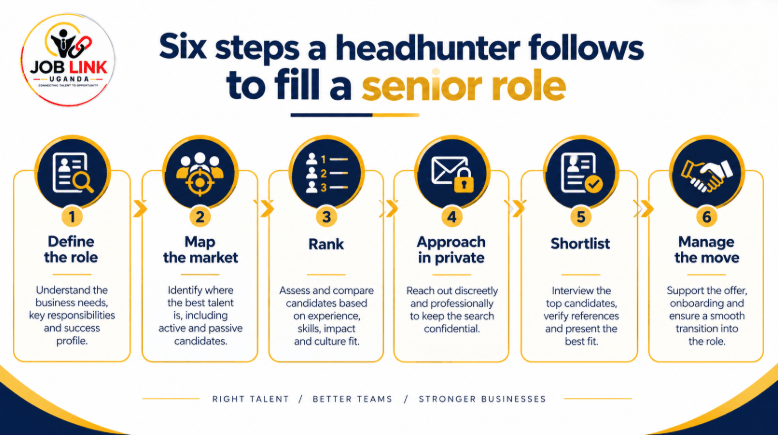
Executive search | Finds senior managers and directors, often by approaching them directly | Experienced leaders |
Staffing and outsourcing | Supplies temporary or contract workers to a company | People who want short-term or contract work |
Overseas placement | Places workers in jobs abroad | Candidates seeking foreign jobs, with strict licensing rules |
Example: A hotel receptionist with four years' experience gets better results from a hospitality specialist than from a general agency, because the specialist already knows which hotels are hiring.
Action step: Write down your field, your years of experience and your target salary range. Then list two agencies that match that profile.
Treat overseas placement as a separate, regulated business
The Employment (Recruitment of Ugandan Migrant Workers Abroad) Regulations, 2005 say that no one may transact business as a recruitment agency without a valid licence. In February 2026 the minister repeated that only companies licensed by the Ministry of Gender, Labour and Social Development may place Ugandans overseas, and that individual agents cannot be licensed, as Pulse Uganda reported. Rules can be updated, so confirm the current position with the Ministry. Read our full guide on how to verify an agency for jobs abroad.
Action step: Never discuss a job abroad with someone who cannot show a current licence you can verify with the Ministry.
The best agencies pass seven simple checks
Lists of "top" agencies change with every ranking, and you often cannot tell how they were put together. A better approach is to measure each agency against the same criteria. Score every agency you consider out of seven.
Check | What good looks like | Red flag |
|---|---|---|
Real office | A physical address in Kampala or another town you can visit | WhatsApp-only contact, no address |
Business registration | A registered business name and a contact person | Refuses to share registration details |
Clear fees | Employers pay for local placements; any candidate fee is explained in writing | Asks you for money before or instead of a job |
Track record | Names the kind of employers and roles it fills, and gives references | Claims "hundreds of jobs" without examples |
Specialist fit | Focuses on your field or level | Promises jobs in every field |
Honest communication | Tells you the stage of your application and the likely wait | Disappears, or pressures you to decide at once |
Verified adverts | Roles link to real employers or a clear client description | Vague jobs, free email addresses, no company named |
Ask who pays, in plain words
On local jobs, most reputable agencies are paid by the employer. Ask: "Who pays your fee, and is there any cost to me?" A straight answer is a good sign. For jobs abroad, the 2005 regulations allowed a nominal fee of no more than UGX 50,000 for recruitment services and placement fees only after the worker signs the contract, with receipts, but they also bar taking money before a job is obtained, according to the text on ULII. Those rules may have changed, so confirm the current fee rules with the Ministry before paying anything. If an agency refuses to put its fees in writing, leave.
Example: An agency says, "Our client pays us. You pay nothing for this teller job." It then sends a written interview invitation from a company email. That is how it should go.
Action step: Send every agency the same message: "Do you charge candidates for local placements? Please reply in writing." Keep the answers.
Visit the office before you share your documents
A 20-minute visit tells you more than a polished website. Look for staff, a working space, a reception and a clear process for receiving CVs.
Example: A candidate visits an agency in Kampala, meets a named consultant, and gets a written note on the roles the agency fills. Another agency refuses to meet and asks for her ID by WhatsApp. She drops the second one.
Action step: Call to book a visit. If the agency will only deal by chat, treat that as a warning.
Reputation checks take an afternoon and can save you months
You do not need inside contacts to check an agency. You need a list of questions, a few phone calls and some patience.
Ask these seven questions before you register
- Which employers or sectors do you recruit for right now?
- Who pays your fee, and is there any cost to me?
- What happens after I send my CV, and how long does it take?
- How will you contact me, and from which number or email?
- Will you ask for my documents now or only at the offer stage?
- Can you share a reference or a recent placement story, without naming private details?
- If you place me abroad, can you show your licence and the approved job order?
A good agency answers calmly and in writing. A bad one dodges, or says "do not worry, just send the money".
Example: A job seeker emails these questions to three agencies. Two reply with clear answers the same week. The third replies with a mobile money number. She registers with the first two.
Action step: Copy the questions into an email template and send them to three agencies this week.
Check what others say, and double-check the sender
Look at the agency's website, social media and any reviews, but remember that anyone can post praise. Talk to someone who was placed by the agency if you can. Then confirm that the vacancy exists by contacting the employer or checking its careers page, as we explain in our guide to spotting fake job adverts.
Action step: Ask two people you know whether they have used the agency and what happened.
Protect your documents until it matters
Share your CV freely, but hold back your ID, passport copy and certificates until you have a real vacancy and a named employer. Employers often verify documents later, as described in our guide to background checks.
Action step: Send only your CV first. Share certificates when you are shortlisted for a specific role.
Candidates who make the recruiter's job easy get shortlisted first
An agency sees many CVs for each opening. It sends forward the people who are clear, quick to respond and honest about what they want. You can control all three.
Send a CV the consultant can place in one minute
Use a clean one- or two-page layout with your target role, key skills and dates in order. Follow our CV format guide for Uganda and name the file with your name and role, for example "Grace-Akello-Accountant.pdf".
Example: A consultant has ten minutes to scan 40 CVs. She forwards the five that state the role, years of experience and key skills in the first few lines.
Action step: Put your target job title and years of experience in the first line of your CV.
Answer fast, be honest and keep it professional
Reply to calls and emails within a day when you can. Tell the consultant your real salary range and notice period, and say if you are talking to other employers. Honest information helps the agency match you well. Brush up with our guide to common interview questions before the first interview.
Example: A candidate says he can start in two weeks and expects UGX 1.8 million. The consultant knows exactly which roles to offer him.
Action step: Write your expected pay, notice period and preferred location on a note and keep it next to your phone.
Follow up once a week, not once an hour
A short message every week or two keeps you in mind without annoying anyone. Ask whether any new openings match you and whether your CV needs changes. You can also see current openings in Kampala while you wait.
Action step: Set a weekly reminder to send one polite follow-up and update your CV if anything has changed.
Frequently asked questions
How do I choose a recruitment agency in Uganda?
Check for a real office, a registered business, written fee terms, a clear track record in your field and honest communication. Ask who pays the fee and avoid any agency that asks for money before a job.
Do recruitment agencies in Uganda charge job seekers?
On local placements, employers usually pay the agency, so you should be able to register for free. Rules for overseas placement are stricter and may allow limited, receipted fees, so confirm the current rules with the Ministry of Gender, Labour and Social Development.
How do I know if an agency can send me abroad?
Only companies licensed by the Ministry of Gender, Labour and Social Development may place Ugandans overseas, and individual agents cannot be licensed. Ask to see the licence and confirm it with the Ministry.
Can I register with more than one recruitment agency?
Yes. Many job seekers register with two or three agencies that match their field. Tell each one honestly where else you are applying so roles are not duplicated.
How long does it take an agency to find me a job?
It depends on your field, your experience and current demand. Expect to hear from a good agency about next steps within a few days, even if a placement takes weeks or months.
Choose the agency that treats you like a candidate, not a customer
The right agency has a real office, tells you how it makes money, knows your field and keeps you informed. Use the seven checks, ask the seven questions and protect your documents until a real vacancy appears. Do that and you will spend less time chasing silence and more time interviewing.
Looking for a hiring partner you can trust? Submit your CV to Job link uganda and our consultants will match you with suitable roles, or see current openings today.
Sources
- The Employment (Recruitment of Ugandan Migrant Workers Abroad) Regulations, 2005, ULII (licensing, fees and prohibited conduct, as published; the rules may have since changed)
- Government warns tour companies engaging in labour externalisation, Pulse Uganda, 5 February 2026