
Executive Search in Uganda: How Headhunters Fill Senior Management Roles
The best senior jobs often reach you by phone call, not advert. Learn how Uganda’s headhunters find leaders and how to be found.
By Akanyijuka Asiraf ·
Executive Search in Uganda: How Headhunters Fill Senior Management Roles
Headline options
- Executive Search in Uganda: How Headhunters Fill Senior Management Roles
- Why Some of the Best Senior Jobs in Uganda Are Never Advertised
- How to Get Noticed by Headhunters in Uganda (Even If You Are Not Job Hunting)
- Executive Recruitment in Kampala: What Happens After a Headhunter Calls
- Senior Management Jobs in Uganda: A Plain Guide to Executive Search Firms
Start here
You have run teams for years, yet you rarely see a senior role advertised that fits you. That is because some of those jobs are filled quietly, by headhunters who call the right person instead of posting an advert. This guide explains how executive search works in Uganda, how headhunters find senior managers, and what you can do to be the person they call.
The short version
- Executive search (headhunting) fills a few senior roles with a personal, often confidential approach, not a public advert.
- Headhunters mainly look for people who are already employed and not job hunting.
- Your visible record matters: a sharp CV, a current LinkedIn profile and a clear reputation in your sector.
- If a headhunter calls, ask about the role, the employer and the process before you share details. Keep the talks private.
- Real executive recruiters are paid by the hiring company. Be careful with anyone who asks you for money.
Executive search is a targeted hunt, not a job advert
Executive search, also called headhunting, is a recruitment service for senior roles. Zoho's guide to executive search describes it as focused on a small number of roles with a personal approach, rather than high-volume hiring. The recruiter goes to the candidate. The candidate does not go to the recruiter.
The sources in this post describe the general practice worldwide, not Uganda alone. Local firms may work a little differently, so ask each firm how it operates.
See how it differs from ordinary recruitment
Ordinary recruitment | Executive search | |
|---|---|---|
Roles | Many entry and mid-level jobs | A few senior roles, such as directors, heads of department and country managers |
How candidates are found | Adverts, CV databases, referrals | Direct, private approach to people already working |
Who is targeted | Active job seekers | Mostly people who are employed and not looking |
Pace | Weeks | Often longer, because candidates need convincing |
Privacy | Usually open | Often confidential |
Example: A bank needs a new head of credit. Instead of posting an advert, its headhunter lists the five best credit leaders in the market and phones each one. Three take the call.
Action step: Write down the senior role you could realistically hold in two years. That is the role a headhunter would be searching for.
Understand retained and contingent search
In retained search, the hiring company pays the firm at stages during the search, whether or not a hire is made. In contingent search, the firm is paid only when a candidate is placed. JRG Partners notes that senior executive searches are usually retained, and that contingent work is more common at lower levels. For you as a candidate, the point is simple: the employer pays, and you should not.
Action step: If any "recruiter" asks you to pay for a senior job, stop. See our guide to recruitment agency choices.
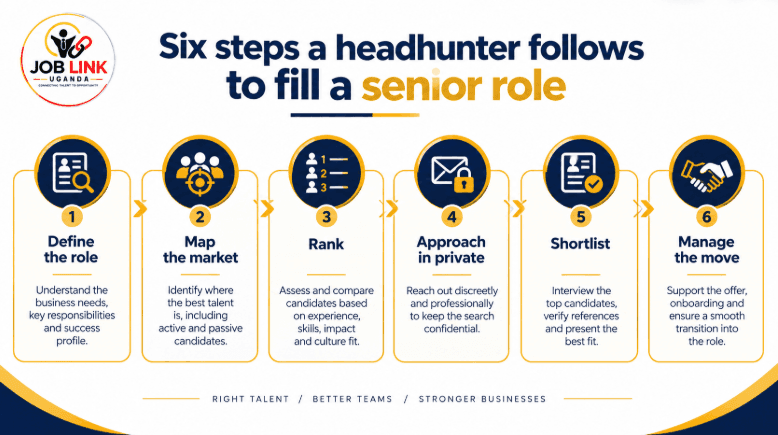
A headhunter works through six steps before you ever hear about a job
Knowing the steps shows you where you can be seen. These stages follow the general process described by Zoho and JRG Partners.
- Define the role. The firm agrees with the client on the duties, skills, pay range and the type of leader the company wants.
- Map the market. The firm lists everyone who could fit, whether or not they are job hunting, and studies pay and skill benchmarks.
- Research and rank. The long list is cut down to the strongest names.
- Approach in private. A consultant contacts the top names directly and discreetly.
- Screen and shortlist. The firm checks skills, strengths, weaknesses and expected pay, then presents a shortlist to the client.
- Manage the move. The firm runs interviews, helps with pay talks and handles issues such as a counteroffer and notice periods.
Get on the list at step two
The market map is built from what the firm can find about you: your public profile, your company's results, your name in the trade press, conference talks and what peers say. If nothing about you is visible, you cannot be mapped.
Example: A finance director speaks on a panel at a banking conference and posts the key points on LinkedIn. A headhunter hunting for a CFO later finds her through both.
Action step: Find three ways to be seen this quarter: speak at one industry event, publish one short article or post, and update your LinkedIn profile (see our LinkedIn profile tips).
Expect a short, careful first call
The first contact is usually a brief private call or message. The consultant describes the role loosely and checks your interest. They may not name the employer at first.
Action step: Prepare a 30-second answer to "What would make you consider a move?" It could be scope, growth, location or mission. Pay is rarely the only reason.
Senior candidates get shortlisted on results, reputation and discretion
Headhunters look for proven leaders who can add value from day one. According to Zoho, they want experts, not people hired for potential. So your proof must be easy to see and easy to check.
Rewrite your CV around results, not duties
A senior CV should open with a short profile and three to five results with numbers: budget managed, team size, revenue or cost change, projects delivered. Keep it to two or three pages. Our CV format guide for Uganda covers the layout.
Example: Weak: "Responsible for branch operations." Strong: "Ran 12 branches and 140 staff; cut loan processing time from 9 days to 4."
Action step: List your five biggest results of the last five years with a number beside each. Put them in the first half of page one.
Keep your online profile current and consistent
Your LinkedIn profile, CV and any company biography should tell the same story, with matching job titles and dates. Add a clear headline with your role and sector, and a photo that looks professional. A mismatch makes a headhunter slow down.
Action step: Open your CV and LinkedIn side by side. Fix every difference in titles, dates and figures.
Protect confidentiality on both sides
If you are employed, do not use your employer's email, phone or time for these talks. Use a personal email and private calls. Ask the consultant how your details will be shared and with whom before you send your CV to a client. Headhunters are expected to handle approaches discreetly, as JRG Partners describes.
Example: A country manager takes a headhunter's call in the evening on her personal phone and asks that her name stays hidden until she agrees to meet the client.
Action step: Set up a personal email address used only for career matters, and send it to your trusted contacts.
Check the headhunter, too
Ask which clients the firm serves, who pays them and how they will treat your details. Never pay a fee to be "considered" for a senior role. Our guide to spotting fake job adverts shows common tricks, which also reach senior professionals.
Treat the headhunter as a partner and plan for the pay and offer talks
Once you are on the shortlist, the process moves fast and the stakes rise. A calm, prepared candidate stands out.
Prepare for senior-level interviews
Expect questions about results, team leadership, handling conflict and your plan for the first 90 days. Use real numbers and short stories. Practise with our guide to interview questions.
Example: Asked about a turnaround, a candidate says: "Sales fell 20% in my first quarter. I changed targets, retrained the team and recovered it in six months."
Action step: Write three leadership stories, each with a problem, your action and a measurable result.
Be open about pay and what you really want
A headhunter negotiates inside the budget set by the client, so honest figures help. Share your current package and your target range, and say what else matters: car, medical cover, housing, bonus or flexibility. Check market ranges first in our salary guide.
Example: A candidate asks for a 20% rise and the consultant explains the budget tops out at 12%. The candidate accepts after the client adds a performance bonus.
Action step: Write down your minimum acceptable package, your target and the non-cash items you value.
Plan for references, checks and a counteroffer
Senior hires usually involve reference checks and verification of papers, as explained in our guide to employee background checks. If you are employed, your current employer may counteroffer when you resign. JRG Partners lists counteroffers and transition issues among the things a headhunter helps manage. Decide in advance whether any counteroffer could change your mind.
Action step: Tell two referees now that they may get a call, and keep copies of your degrees and certificates ready.
Read the contract before you resign
Check the title, pay, notice, probation and duties in writing before you hand in notice. Our overview of the probation period in Uganda and the Employment Act summary explain the basics.
Action step: Do not resign until you hold a signed offer that matches what was promised.
Frequently asked questions
What is executive search in Uganda?
Executive search, or headhunting, is a recruitment service that finds candidates for senior roles such as directors and heads of department. The firm approaches suitable people directly and often confidentially, instead of waiting for applications.
How do headhunters find candidates?
They define the role with the client, map everyone who could fit, rank the best names and approach them directly. Many of the people they target are already employed and not job hunting.
Do I pay a headhunter to get a senior job?
No. Executive search firms are paid by the hiring company, often in stages on retained searches. Be careful with anyone who asks a candidate for a fee.
How can I get noticed by headhunters in Kampala?
Keep a results-focused CV and a current LinkedIn profile, speak or publish in your field, and build a name with peers and industry bodies. Visibility lets a headhunter find you when mapping the market.
Is executive search confidential?
Usually, yes. Approaches and shortlists are typically handled discreetly, but ask each firm how it will share your details and with whom before you send your CV.
Be the senior name a headhunter already knows
Executive search rewards people who are visible, prepared and discreet. Build a results-first CV, keep your profile current, let trusted contacts know what you are open to, and ask clear questions when a consultant calls. Do that and the next senior role may come to you.
Ready to put your experience in front of employers? Submit your CV to Job Link Uganda, or see current openings today.
Sources
- A deep dive into executive search, Zoho Recruit (general practice, not specific to Uganda)
- What Is Executive Headhunting? How Headhunters Actually Work, JRG Partners (general practice, not specific to Uganda)