Employee Background Checks in Uganda: References, Academic Papers and Police Clearance
Got a conditional offer? Learn what employers check in Uganda and how to prepare your referees, papers and police clearance.
By Akanyijuka Asiraf · · Updated

Employee Background Checks in Uganda: References, Academic Papers and Police Clearance
Headline options
- Employee Background Checks in Uganda: References, Academic Papers and Police Clearance
- Got a Job Offer in Uganda? Here Is What a Background Check Will Look At
- How to Pass an Employee Background Check in Uganda (Without Last-Minute Panic)
- Police Clearance, Reference Checks and Certificate Verification: A Job Seeker's Guide for Uganda
- What Employers in Uganda Really Check Before They Confirm Your Job
Start here
The employer loves you, then an email arrives: "Please send your police clearance, certificates and two referees by Friday." Some candidates lose days, or even the offer, because they start gathering papers only after the offer. This guide explains what a background check covers in Uganda, how each part works and how to be ready before anyone asks.
The short version
- A background check confirms that you are who you say you are and that your record matches your CV.
- The three common parts are references, academic documents and police clearance (the Certificate of Good Conduct).
- Police say the certificate costs UGX 76,000 and takes five working days after fingerprints, as reported in November 2024. Confirm the current fee and time.
- UNEB charges UGX 50,000 for an ordinary verification letter for an individual, per its online form.
- Start early, tell your referees, keep honest records and use official channels only. Avoid brokers.
A background check confirms your story before the employer commits
A background check is the step where an employer or recruiter verifies the facts on your CV. It is usually done after a successful interview and before a final offer or start date. Employers run checks because a hire costs money and trust, and they want to avoid false papers or a hidden risk, especially for jobs that handle cash, children, health or sensitive data.
Checks vary by employer and role, so ask what yours will include.
Know the five things employers may check
Check | What the employer wants to know | Common for |
|---|---|---|
Identity | You are who you say you are | All roles |
References | How you performed and behaved in past jobs | Most roles |
Academic documents | Your certificates and results are genuine | Roles that require a qualification |
Police clearance | You have no record that makes the role unsafe | Roles with cash, children, security or trust |
Employment history | Your dates and job titles match your CV | Mid and senior roles |
Example: A bank offers a cashier job subject to ID, two referees, academic papers and a Certificate of Good Conduct. The candidate has until the end of the week to deliver.
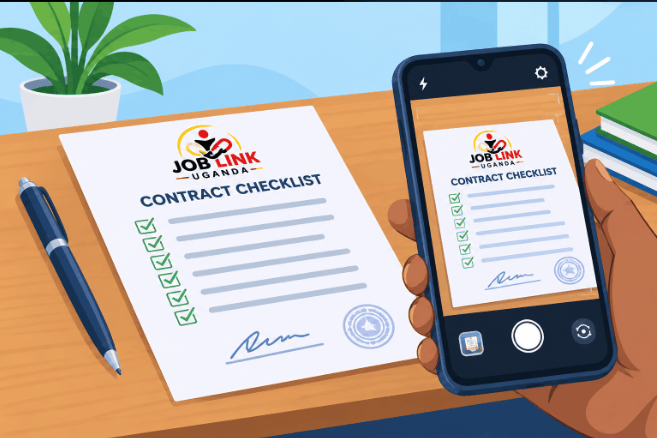
Action step: Write a checklist of the five items and tick off those you already have. Then plan the missing ones.
Make your CV match your documents exactly
Most trouble comes from small mismatches: a different spelling of your name, a wrong year or a job title you stretched. Keep your CV honest and consistent with your certificates. Our CV format guide for Uganda shows how to list dates and titles clearly.
Action step: Put your CV and certificates side by side. Fix any difference in names, dates and grades.
A reference check is a short call that can confirm or sink your story
In a reference check, the employer or recruiter calls or emails people who know your work and asks about your role, dates, strengths and reason for leaving. It is often the first check to start, and it can be quick. Prepare your referees as carefully as you prepare for the interview.
Choose referees who know your work and will pick up the phone
Good referees include a former supervisor, a manager at a past internship or a lecturer who supervised your project. Family members are rarely accepted. Pick people who will speak clearly and positively about specific work you did.
Example: A graduate lists her internship supervisor and a lecturer. The employer reaches both within a day, and both describe her reports and reliability in the same way as her CV.
Action step: Choose two or three referees. Ask each one first and write down their title, phone number and email.
Brief your referees before the call
Send each referee your CV, the job description and the dates you worked together. Remind them of one or two results you are proud of. A referee who has the facts will not freeze or guess.
Example: A candidate emails his former manager: "I applied for a stores supervisor role. You may get a call. I led the monthly stock count and cut mismatches by half in 2024." The manager repeats the same details to the recruiter.
Action step: Send each referee a three-line message with the role, your key result and the date you expect the call. Thank them afterwards.
Be ready for the questions
Expect questions such as: "How long did they work for you? What were they responsible for? How was their attendance? Would you rehire them?" Practise your own answers with our guide to common interview questions, so they match your referees' answers.
Action step: Write down your reason for leaving each past job in one honest sentence.
Academic verification needs the right letter from the right office
Employers may ask the school, the examinations board or the university to confirm your results. Having the paperwork ready saves days. A false or altered document can end your application, even if you were otherwise qualified, so never submit a paper you cannot prove.
Get your O-level and A-level results verified through UNEB
The Uganda National Examinations Board (UNEB) has an online form for individuals to apply for verification, confirmation, replacement or certification of results slips or certificates. According to that form, you need:
- An introduction letter from your former school, addressed to the Executive Secretary, UNEB
- A valid identity card
- A police letter if your slip or certificate was lost or damaged
- Files in PDF, JPG or JPEG format, no larger than 2MB each
The listed fees are UGX 50,000 for an ordinary letter and UGX 100,000 for a hard-card letter (a substitute for a certificate), and UGX 300,000 for political or special verification. Payment is by Airtel or MTN Mobile Money or by bank deposit. Fees and rules can change, so check the page before you apply.
Example: A candidate applies for a bank job and is asked to verify his A-level results. He gets an introduction letter from his old school, uploads it with his ID on the UNEB form and pays through mobile money.
Action step: Contact your former school this week and ask for an introduction letter addressed to the UNEB Executive Secretary. Keep a scan of it.
Check what your university or college needs to confirm
For degrees and diplomas, the awarding institution usually confirms the award. Contact the registrar's or academic office and ask what they need, how long it takes and what they charge. Requirements differ by institution, so ask before you promise a date.
Action step: Request two certified copies of your degree and transcript and a short verification letter if the institution offers one.
Plan ahead for foreign qualifications
If you studied abroad, ask the employer whether it needs the qualification to be recognised in Uganda. UNEB lists an equating service for foreign qualifications. Check that page and ask the employer what proof it accepts.
Action step: Ask your recruiter or employer in writing what it requires for foreign certificates before you pay for any service.
The police Certificate of Good Conduct takes fingerprints, a fee and about a week
A police clearance, called a Certificate of Good Conduct, shows whether the police hold a criminal record about you. Employers ask for it for roles in banks, security, schools, health and any job with cash or vulnerable people. Apply early, because you cannot get it the same day.
Know the steps and the cost
The Uganda Police Force announced in November 2024 that it had cut processing time from seven working days to five, as Kampala Post reported. The report said applicants register on the Uganda Police website, complete the form, pay the fees and book a fingerprint appointment. The certificate costs UGX 76,000, with extra charges of UGX 2,300 for bank payments and UGX 3,700 for MTN Mobile Money. A help desk is at the Interpol office on Plot 12, Mabua Road, Kololo, and applicants can write to Interpol@upf.go.ug.
Canada's immigration guidance on Ugandan police certificates says the certificate is issued by the Directorate of Interpol and International Relations of the Uganda Police, that fingerprints are taken in person for applicants in Uganda, and that applicants provide a copy of their ID, two passport-style photos and a letter of introduction explaining why the certificate is needed. See the guidance. Fees, timing and steps may have changed, so confirm on the official Uganda Police site before you pay.
Example: A candidate gets a conditional offer on Monday. She registers online, pays and books fingerprints that week. Five working days later she collects the certificate and sends it to HR.
Action step: Prepare your ID copy, two photos and a letter from your employer stating that the certificate is needed. Then register on the official police site.
Skip brokers and fixers
The same police announcement urged the public not to use brokers or middlemen when applying. Paying a fixer risks your money, your personal data and your job if the paper turns out to be fake.
Action step: Use only the official police website and help desk. If someone offers a "fast" certificate, report it and walk away.
Prepare early, share data carefully and fix problems before they cost you the job
Background checks go smoothly for people who plan. They go badly for people who rush, guess or hide things.
Build a background check folder now
Create one folder, on paper and on your phone, with your ID, passport photos, certificates, transcripts, reference letters, referee contacts and any past contracts or payslips. Add the police clearance once you have it. Having everything in one place lets you answer an employer in minutes.
Example: A candidate gets a conditional offer at 4 p.m. and sends the full pack by 4:30 p.m. The employer notes how organised he is.
Action step: Spend one hour this weekend scanning each document and naming the files clearly, such as "Name_UCE_certificate.pdf".
Share personal documents only with a real employer or agency
Only send your ID and certificates once you have a real vacancy and a named employer. Scammers use "background check fees" to take money from job seekers. A genuine employer or agency does not charge you for its own check. For the application itself you may need to pay the official fee to the police or UNEB, but you pay that to those offices, not to a recruiter. Read our guide to fake job scams.
Action step: If a recruiter asks you to pay "for the check", ask for the official receipt route and verify the employer first.
Be honest about gaps and mistakes
A gap in your CV, a repeated year or a past dismissal is easier to explain than to hide. Prepare a short, honest explanation and offer proof where you can. If a record has a mistake, such as a misspelled name, ask the issuing office to correct it before the check.
Example: A candidate had a six-month gap while caring for a sick parent. He explains it in one sentence in the interview, and the employer moves on.
Action step: Write a one-sentence explanation for any gap or change in your CV, and keep any supporting letter.
Frequently asked questions
What does a background check include in Uganda?
Usually identity, references and academic documents, and for some roles police clearance and employment history. The exact checks depend on the employer and the job, so ask what yours includes.
How do I get a police clearance certificate in Uganda?
Apply for a Certificate of Good Conduct through the Uganda Police Force: register online, complete the form, pay the fee and attend a fingerprint appointment. In November 2024 police reported a fee of UGX 76,000 and a five-working-day turnaround. Confirm current details on the official police site.
How do I verify my UNEB results for a job?
Apply through UNEB's online form for individuals. You need an introduction letter from your former school addressed to the UNEB Executive Secretary and a valid ID. The listed fee for an ordinary letter is UGX 50,000. Check the page for current rules.
How long does a background check take?
It depends on the employer and which checks apply. Reference calls can take a day or two, while police clearance involves fingerprints and about five working days after processing starts, so begin early.
Do I pay a recruiter for a background check?
No. A genuine employer or agency does not charge you for its own check. You pay official fees only to offices such as the police or UNEB. Verify the employer before sharing any document.
Get your papers in order before the offer arrives
A background check is a fact check, and honest candidates with organised papers pass it easily. Choose referees and brief them, order your academic letters, book your police clearance early and keep every document in one folder. Then a request from an employer becomes a quick reply, not a scramble.
Want a recruiter who explains each step before the check starts? Submit your CV to Job Link Uganda, or see current openings today.
Sources
- Police cuts Certificate of Good Conduct processing time to 5 days, Kampala Post, 13 November 2024
- How to get a police certificate: Uganda, Government of Canada (no date shown; process may have changed)
- UNEB e-Services: Apply for Letters of Verification as an Individual, Uganda National Examinations Board
- Equating of Foreign Qualifications, UNEB (page listed, not read in full)