
Rights of Ugandan Migrant Workers in the Middle East: Contracts, Pay and Help Lines
Know your contract, pay and help lines before you fly. A clear guide to the rights of Ugandan migrant workers in the Middle East.
By Akanyijuka Asiraf · · Updated
Rights of Ugandan Migrant Workers in the Middle East: Contracts, Pay and Help Lines
Five headline options
- Direct: Rights of Ugandan Migrant Workers in the Middle East: Contracts, Pay and Help Lines
- Benefit-driven: Know Your Rights Before You Fly: A Ugandan Worker's Guide to Contracts, Pay and Help in the Gulf
- Curiosity: What Your Employer in the Middle East Cannot Legally Do to You (and Who to Call If They Try)
- Benefit-driven: Working in the Gulf as a Ugandan? Here Is Exactly What Your Contract and Salary Must Protect
- Curiosity: Held Passport, Missing Wages, Changed Contract: What Ugandan Workers Abroad Can Do Next
Your salary is three months late, and the contract in your employer's hand is not the one you signed in Kampala. Many Ugandans working in the Gulf have faced exactly this, and most did not know who to call.
You have rights before you leave, while you work and if things go wrong, and knowing them in advance is the best protection you can carry. This guide explains what your contract should say, what you are owed, and which help lines to save in your phone before your flight.
TL;DR
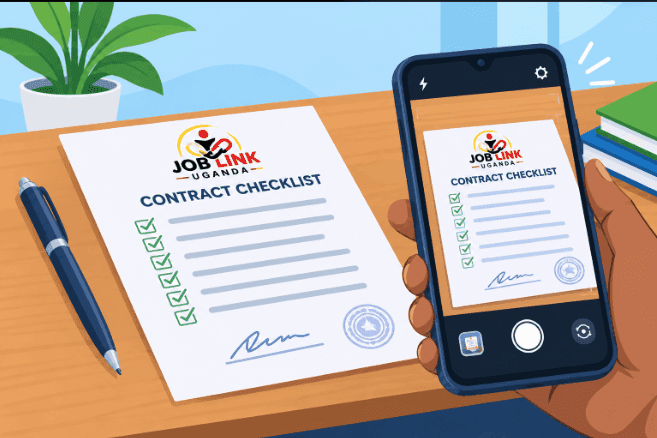
- Your contract should be in writing, and you should read, understand and photograph it before you travel. Uganda's new model has four parties: you, the foreign employer, the Ugandan agency and the government.
- Domestic workers should pay no recruitment fees, and must complete a 14-day orientation before leaving.
- Keep your own records of pay, hours and messages from day one.
- Save Sauti 116, the ministry's online complaints platform and your embassy's number before you fly. Your family can report for you.
Your contract is your strongest protection, so get it right before you fly
A written contract turns promises into something you can prove. Uganda's government now describes a four-party contract that binds the worker, the foreign employer, the Ugandan recruitment agency and the government, and says the agency shares responsibility for your welfare abroad (Matooke Republic, Feb 2026).
Check these seven points on the contract before you sign
- The employer's full name and country
- Your job title and duties (a promised bank job that turns into housework is a classic switch)
- Your monthly salary, the currency and the pay date
- Daily hours, weekly rest day and annual leave
- Housing and food: who provides them, and whether anything is deducted
- How long the contract runs and how it can end
- Who pays your return ticket
The fifth and seventh points are the ones people forget to ask about, so ask the agency to answer them in writing.
Contract switching is a documented problem, so keep your own copy
Ugandan reporting has described complaints of wage theft and contract substitution among workers in the Gulf (Nile Post, Nov 2024, via Business & Human Rights Resource Centre). Take clear photos of every page of your signed contract, then send them to a family member. The government also advises sharing signed contracts with family before departure. If you are handed a different paper on arrival, you have proof of what you agreed to.
Domestic workers have extra safeguards on paper
If you are going as a housemaid or nanny, the ministry says you should not be charged recruitment fees and must complete a 14-day pre-departure orientation. The same rules say you can check the agency and job offer on the ministry's EEMIS system before signing anything. Saudi Arabia and Uganda also signed a domestic worker agreement in 2023, though press reports of it (Saudi Gazette, March 2023) did not publish wage figures. Read your own contract for the number that applies to you.
You are owed the pay in your contract, on time and without surprise deductions
Salary is the first right to protect, because late or missing pay is the first sign of trouble. Uganda's 2021 recruitment regulations make it an offence to withhold a worker's salary without a justifiable reason, and they allow licences to be revoked, suspended or cancelled for breaches (The Independent, 2021). Those rules bind Ugandan agencies, so the agency that placed you has a duty to act when pay stops.
Keep a pay diary from your first week
A simple record is hard for anyone to argue with. Write down the date and amount of each payment, and screenshot any mobile money or bank transfer. Save messages where your employer promises or refuses pay. If your salary stops, you will have a timeline to give the ministry or your embassy instead of memories.
Know which fees you should and should not pay
Fees are where many Ugandan workers lose money before they even fly. In 2021 Cabinet scrapped fees charged to people seeking jobs in Saudi Arabia, saying the foreign employer already covers placement costs under the bilateral agreement (Daily Monitor, Sept 2021). For domestic workers, the ministry's current message is no recruitment fees at all. Other jobs and destinations have different rules, so ask the agency for the approved fee in writing and confirm it with the ministry. Our guide to recruitment agency fees shows what a receipt should look like.
Do not hand your passport to a broker
Some Ugandan women have reported that their passports were taken on arrival, leaving them unable to leave a bad job (Equal Times, 2017). Rules on passport holding differ by country, so ask your agency and the ministry what applies at your destination. Photograph your passport's photo page and visa now, and send the images to a family member. If anyone insists on keeping the original, treat it as a red flag and call for help early.
Rest, safety and a working phone are rights worth insisting on
A contract that lists hours, a weekly rest day and housing gives you something to point to when work stretches past what you agreed. Ugandan returnees have described days of more than 15 hours without breaks (Equal Times, 2017), and others described employers who limited their phone access (Global Press Journal, 2021). Those stories are not every worker's experience, but they show why the points below matter.
Agree on hours, rest and leave before you leave Uganda
If the contract is vague about hours or rest days, ask the agency to get the employer to fix it in writing. The UAE, for example, passed a domestic worker law that includes rest days and paid annual leave, though rights groups said it is weaker than the general labour law (Equal Times, 2017). Laws change, so ask the ministry which rules apply in your destination today.
Keep a phone and three saved contacts
Before you fly, save these in your phone and write them on paper in your bag: the Sauti 116 helpline, your embassy's number, and one relative who knows your contract. A worker who can reach someone can ask for help early, and early reports are easier to act on.
Your health and safety come before the contract
If you are hurt, threatened or locked in, get to safety first and worry about wages later. Tell a trusted person, contact your embassy and call 116. Cabinet also announced in 2021 that it would set up safe shelters for distressed workers in Qatar, Saudi Arabia and the UAE (Daily Monitor, Sept 2021). Ask your agency, before you leave, where those shelters are and how to reach them.
Know who to call, and in what order, when something goes wrong
There is no single number that solves every case, so build a short list of contacts before you travel. The ministry tells workers to report abuse or contract violations quickly, and says families can report too (Matooke Republic, Feb 2026).
Who | Use them for | How to reach them |
|---|---|---|
Sauti 116 helpline | Reporting abuse, unpaid wages or a changed contract, by you or your family | Dial 116 |
Ministry of Gender, Labour and Social Development | Complaints about an agency, and checking its licence | Complaints module on EEMIS (eemis.mglsd.go.ug); phone +256 414 341 250, as published in Nile Post, Feb 2026. Confirm before you rely on it. |
Ugandan embassy in your destination (for example, Riyadh for Saudi Arabia) | Emergencies, lost documents, help leaving a dangerous situation | Get the number from the Ministry of Foreign Affairs before you leave and save it |
Your recruitment agency | Pay and contract problems it must help fix, since it shares responsibility | Contacts on your contract |
Worker groups such as NOTU and Platform for Labour Action | Tracing a missing worker and pushing a case | Search their official pages; NOTU helped one returnee reach the embassy (Equal Times, 2017) |
A simple order of action when your rights are broken
- Get to a safe place if you are in danger.
- Tell your family and send them photos of your contract, passport and any messages.
- Call Sauti 116, or ask your family to call on your behalf.
- Contact your embassy and give your employer's name, address and your passport number.
- Tell the agency in writing, and keep a copy.
Do not wait until you are home to speak up
One returnee told reporters she had never heard of the embassy and did not know how it could help, and another did not file a complaint because she did not think anyone would help (Global Press Journal, 2021). Reports made early, with records, give officials something to act on. If you are already back in Uganda, a residential centre in Entebbe has offered counselling to returnees since 2018, according to the same report.
Frequently asked questions
What should I do if my employer changes my contract after I arrive?
Do not sign anything you do not understand. Photograph the new paper, show them your original contract photos, and report the change to Sauti 116, your embassy and your agency. Contract substitution has been reported in Ugandan cases, so a saved copy of the original is your best proof.
Do I have to pay recruitment fees to work abroad?
It depends on the job and destination. The ministry says domestic workers should not be charged recruitment fees, and Cabinet scrapped fees for Saudi Arabia in 2021. Ask for any approved fee in writing, get a receipt, and confirm it with the ministry.
Can my family report a problem for me?
Yes. The ministry says families can report abuse or contract violations through Sauti 116 or its online complaints platform. Give your family your employer's name, address and your passport number before you travel.
Who can I contact if I am in trouble in Saudi Arabia?
Your first contacts are the Ugandan embassy in Riyadh, Sauti 116 and your recruitment agency. Save the embassy's number before you fly, since this guide could not confirm a current public number.
Can I take legal action if I am cheated?
Possibly. One Ugandan lawyer argued in 2020 that a Ugandan court could hear a case against a Ugandan-licensed agency, but this is an opinion, not a promise (Nile Post, 2020). Speak to a lawyer or a workers' group for advice on your own case.
Rights only help when you know them before you board
Your best protection is a written contract you understand, a pay diary, copies of your documents with your family, and three saved contacts. None of it costs much, and all of it makes a complaint easier to act on. If you are still choosing how to go, start with our guide to jobs abroad for Ugandans and check any agency with our steps to verify a recruitment agency.
Have a contract in your hands and want a second pair of eyes? Talk to Job Link Uganda or see current openings.
Sources
These are news, advocacy and opinion articles, not the law itself. Rules and phone numbers change, so confirm them with the Ministry of Gender, Labour and Social Development before you rely on them.
- Matooke Republic, 6 Feb 2026: government tightens rules to protect Ugandans seeking jobs in the Middle East
- Business & Human Rights Resource Centre, 2 Nov 2024 (Nile Post): complaints of wage theft, contract substitution and trafficking
- The Independent: Employment (Recruitment of Ugandan Migrant Workers) Regulations 2021
- Daily Monitor, 30 Sept 2021: Cabinet scraps migrant worker fees
- Equal Times, 16 June 2017: Ugandan domestic workers
- Global Press Journal, Dec 2021: migrant workers abused in the Middle East
- Nile Post, 3 Aug 2020: opinion on workers' legal options
- Nile Post, 5 Feb 2026, and Saudi Gazette, March 2023 (consulted for the helpline details and the Saudi domestic worker agreement)