Jobs Abroad for Ugandans: Legal Routes, Top Destinations and Requirements
Want to work abroad from Uganda? Learn the legal route, common destinations, documents you need and the red flags to avoid.
By Akanyijuka Asiraf ·

Jobs Abroad for Ugandans: Legal Routes, Top Destinations and Requirements
Headline options
- Jobs Abroad for Ugandans: Legal Routes, Top Destinations and Requirements
- Want to Work Abroad From Uganda? Check These Five Things Before You Pay Anyone
- Overseas Jobs for Ugandans: How to Go Legally and Avoid Scams
- Work Abroad From Uganda the Safe Way: A Step-by-Step Guide
- Why Some Ugandans Land Overseas Jobs and Others Lose Their Money
Start here
A friend sends you a message about a high-paying job abroad, and all you need to do is pay a fee. Many Ugandans have lost millions of shillings that way. This guide explains how to work abroad from Uganda legally, which destinations are most common and what you need before you apply.
The short version
- Only licensed recruitment agencies may place Ugandan workers abroad. Check the Ministry of Gender, Labour and Social Development's official list before you pay or sign anything.
- The Gulf (Saudi Arabia, the UAE and Qatar) is the best-known destination for Ugandan workers, and also where most complaints come from.
- For domestic work abroad, the ministry says applicants should not be charged recruitment fees.
- Expect to need a passport, a medical check, a police clearance and a signed contract. Requirements vary by country and employer, so follow the advert.
- Travel only on a proper work visa, and share your signed contract with your family before you leave.
- Report abuse or contract problems through the Sauti 116 helpline.
The legal route runs through a licensed agency
In Uganda, sending workers abroad is called labour externalisation. The Ministry of Gender, Labour and Social Development oversees it, and only licensed recruitment companies are allowed to place Ugandan workers overseas. If a person, a travel agent or a social media page offers you a job abroad, that alone does not make the offer legal.
The government has been tightening the rules
In April 2026, news reports said the ministry published an updated list of licensed firms as of 7 April, and revoked 275 licences for failing to renew and other irregularities. The reports gave different counts of active firms, from "more than 120" to 225, so use the ministry's own current list, not a number from an article. Officials also warned that people were still losing money to traffickers and fraudulent companies.
In February 2026, the government announced new protections for workers heading to Saudi Arabia, the UAE and Qatar. They included:
- A four-party contract between the worker, the foreign employer, the local agency and the government
- Shared responsibility for the agency over the welfare of workers it places
- A 14-day pre-departure orientation for domestic workers
- An online system to check whether a company and its job offers are approved
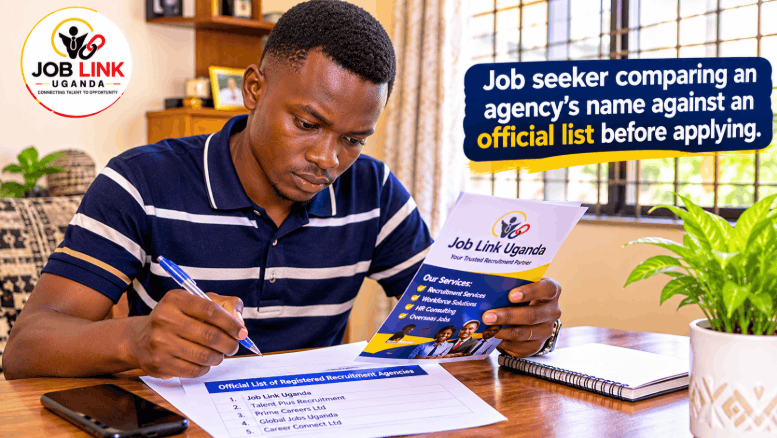
Example: Imagine you receive an offer for a hotel job in Doha from a person who says they "work with an agency." Before you reply, look up the agency's name on the ministry's list. If it is not there, or the name is slightly different, stop and ask the ministry.
Three checks before you pay or sign anything
- Is the agency on the current official list? Names can be copied, so match the exact company name and ask for its licence details.
- Is the job offer approved? Ask for the job order or contract and check it through the ministry's channels.
- Is every fee in writing? Ask for a written breakdown. For domestic work abroad, the ministry's position is that applicants should not be charged recruitment fees.
Do this: Take a photo of the licence, the contract and any receipt, and keep a copy with someone you trust at home.
The Gulf is the main destination, and the risks are real
Most reporting on Ugandan overseas workers points to the Gulf. One report cited an ILO figure of about 270,000 Ugandan migrant workers going to Arab states between 2016 and 2023. The February 2026 government reforms named three countries: Saudi Arabia, the UAE and Qatar.
What work Ugandans go for
Domestic work is the category most often mentioned in official warnings and reforms. Other roles appear in adverts, such as hospitality, security and driving, but demand, pay and requirements change from one employer and country to the next. Treat any advert that lists every job under the sun as a warning sign.
Pay and conditions are set by the contract, so never rely on what a friend or recruiter tells you by phone. Ask to see the pay, hours, rest days, housing and the date your contract ends in writing.
Why the same destination brings good and bad stories
Some Ugandans return with savings and skills. Others report unpaid wages, forced labour and abuse, according to complaints cited by officials. The difference often starts at home: a licensed agency, a clear contract and a pre-departure briefing give you a better chance than a deal arranged on a social media chat.
Example: Two cousins apply for the same type of job in the Gulf. One goes through an agency on the ministry's list, keeps copies of her signed contract and shares them with her mother. The other pays a person she met online and travels on a visit visa. If something goes wrong, only the first has papers and a licensed agency she can name when she asks for help.
Do this: Pick one destination and one job type, then ask the agency for the written job order, pay terms and contract length before you decide. If it cannot give them, move on.
Get your documents ready before you apply
Requirements differ by country, employer and job, so the advert and the agency's job order come first. Most applicants should expect to prepare the following.
- A valid passport. Check the expiry date. Many countries want several months of validity left, so confirm the rule for your destination.
- A police clearance. A Certificate of Good Conduct is a common request. Our guide to employee background checks in Uganda explains how it works.
- A medical check. Employers or destination countries often require one. Ask the agency which clinic is approved, and do not pay a clinic you cannot verify.
- Academic and skills papers. Bring certificates and any proof of experience, such as reference letters.
- A signed contract. Read it before you sign, keep a copy and share it with your family before you travel.
- A work visa. The February 2026 guidance said workers should travel only on employment visas. A tourist or visit visa is not a work permit.
- Pre-departure training. For domestic workers going to the three Gulf countries named in the reforms, the government announced a 14-day orientation.
How to prepare in a few weeks
- Start with the documents that take longest, such as a passport and a police certificate.
- Make two photocopies and a phone photo of every document.
- Write down your agency's name, licence number, office address and the name of your contact person.
- Save the Sauti 116 helpline number in your phone before you leave.
Example: A job seeker applying for a hotel role abroad lines up her certificate, a reference from her last manager and a short CV before she contacts any agency. When the agency asks for documents, she replies the same day.
Spot the red flags before they cost you money
News reports on the 2026 licence revocations cited alleged illegal recruitment fees of UGX 2 million to 8 million, against a government-approved registration fee of UGX 50,000. Treat large upfront payments as a reason to stop and check. Our guide to fake job adverts in Uganda covers the wider pattern.
Warning signs
- The offer comes from a tour or travel company, or from a person on social media. The February 2026 guidance warned job seekers to be careful with these.
- You are asked to pay before you see a written contract.
- You are told to travel on a visit or tourist visa and "change it later."
- Pay sounds far above normal for the job, with no written detail.
- The agency will not give its licence details, or its name is not on the ministry's list.
- You are told not to tell your family or to keep the contract private.
What to do if something feels wrong
- Stop paying and stop sharing documents.
- Check the agency name against the ministry's current list.
- Ask the Ministry of Gender, Labour and Social Development, or call the Sauti 116 helpline, if you are unsure.
- Keep every message, receipt and contract.
The ministry has also said it would help people recover money if a listed firm cheats them, so keep your records.
Example: Imagine a man who is told to pay UGX 3 million "to secure the visa" and to pay in cash. He asks for a written receipt and the agency's licence details. The recruiter stops replying. That reaction told him what he needed to know.
Frequently asked questions
How can I work abroad from Uganda legally?
Apply through a recruitment agency licensed by the Ministry of Gender, Labour and Social Development. Check its name on the ministry's current list, ask for a written job order and contract, and travel only on a work visa.
How do I check if a recruitment agency is licensed?
Match the exact company name to the ministry's published list of licensed firms. In February 2026, the government also pointed to an online system for checking approved companies and job offers. If you are unsure, ask the ministry.
Do I have to pay to get a job abroad?
Fees vary, so ask for a written breakdown before paying anything. For domestic work abroad, the ministry's position is that applicants should not be charged recruitment fees. Be careful with any large upfront payment.
Which countries do Ugandans work in?
The Gulf is the best-known destination. The government's February 2026 reforms named Saudi Arabia, the UAE and Qatar. Job availability and rules change, so confirm them with your agency.
Where do I report abuse or a contract problem?
Call the Sauti 116 helpline or use the ministry's online complaints platform, and keep your contract, messages and receipts.
Check first, pay later, and keep your papers
A job abroad can change your life, and a scam can cost you your savings. Use a licensed agency, read the contract before you sign, travel on a work visa and keep copies of everything. If an offer fails any of those tests, walk away.
If you want help finding a legal route, talk to Job Link Uganda about what is open, or see current openings at home while you plan. To learn how to check an agency, read our guide to licensed external recruitment agencies in Uganda.
Sources
These are news reports, not official publications. Check the ministry's current list and rules before you act.